
MORTGAGE PAYMENT OPTIONS… WHICH IS THE BEST OPTION FOR YOUR SITUATION?
Once your mortgage has been funded by your lender, you need to decide on how frequently you want to make your mortgage payments.
Most people want to pay off their mortgage as quick as possible to save paying interest.
We’ll discuss various mortgage payment options and then do the math by crunching mortgage numbers, keeping in mind: the longer it takes to pay off your mortgage, the more interest you pay.
Monthly:
Most people’s typical payment option. Monthly payments will have the lowest payments therefore your mortgage will be paid off the slowest. For many people this is the most comfortable option, since it’s only one payment a month to plan for.
Bi-Weekly:
Take your monthly mortgage payment multiply by 12 for a year, then divide by 26.
• You will make a mortgage payment every 2 weeks for a total of 26 payments per year.
• This will not help to pay your mortgage off any sooner than regular monthly payments.
Semi-Monthly:
You make payments twice a month for a total of 24 payments a year.
• This will not help to pay your mortgage off any sooner than regular monthly payments.
Weekly:
Take your monthly payments, multiply by 12 for a year, then divide by 52 weeks.
• This will not pay down your mortgage any sooner than regular monthly payments.
Accelerated Bi-weekly:
Your monthly payment divided by 2.
• This option creates 2 extra bi-weekly payments a year, meaning you would be making 13 monthly payments a year (instead of 12). The two extra payments go directly to paying down the principal on your mortgage.
Accelerated Weekly:
Your monthly payment divided by 4.
• This option creates 4 extra weekly payments a year, meaning you would be making 13 monthly payments over a year (instead of 12). The 4 extra payments go directly to paying down the principal on your mortgage.
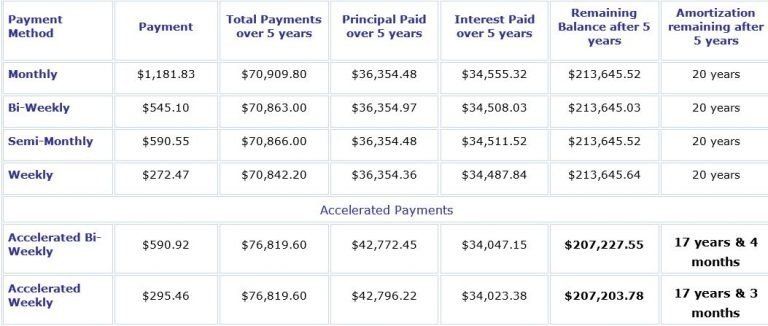
I’ve crunched mortgage numbers by putting together a table using:
• $250,000 mortgage
• Mortgage rate 2.99%
• 5-year term
• Compounded semi-annually
• 25-year amortization
You can see how choosing the accelerated option pays your balance down a lot faster than regular payments.
Mortgages are complicated… Don’t try to sort all this out on your own. Call a DLC Canadian Mortgage Expert and let’s figure out what your best mortgage option will be!
This article was written by Kelly Hudsona DLC Canadian Mortgage Expert. It was originally published here.